
Programs Tuition
Class Schedule & Frequency
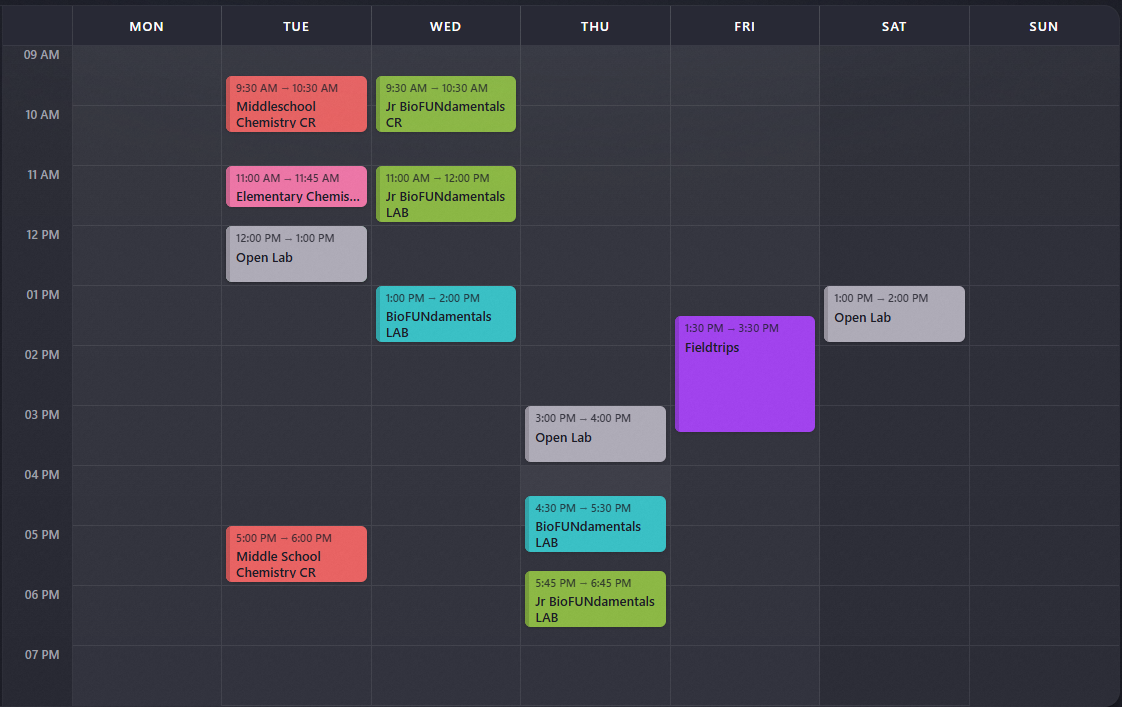
All of our classes meet once (1) per week. If you see a specific course listed multiple times on our timetable, those are identical repeat cohorts designed to fit different family schedules—simply select the single weekly day and time slot that works best for your family.
Pricing Options & Per-Class Breakdown
Our fee-based courses offer convenient monthly tuition installment plans, with several enrollment options designed to keep our nonprofit programs accessible while supporting the financial sustainability of our volunteer-run community lab:
Co-Op Discount Rate: Families contribute approximately 1 hour of volunteer work per month per registered student (such as lab prep, equipment sanitation, or check-in) in exchange for discounted tuition. Total monthly tuition installments for families enrolled under this option are capped at $400 per month.
Standard Rate: Families who prefer not to participate in monthly co-op volunteer duties pay standard tuition, with no volunteer hours required. Standard tuition helps fund part-time operational support.
Barter Track (50% Discount): We offer specialized barter positions (such as Lab Tech, Volunteer Coordinator, or Curriculum Assistant) that provide a 50% discount off standard tuition in exchange for approximately 5 hours of volunteer work per month.
Note: All pricing includes student study guides, lab worksheets, and access to our Skills Tracking Portal. This platform logs your student's completed lab hours, covered topics, and technical skills to simplify high school transcripts, portfolios, and academic resume building.
Course Tuition Installments & Per-Class Cost Breakdown:
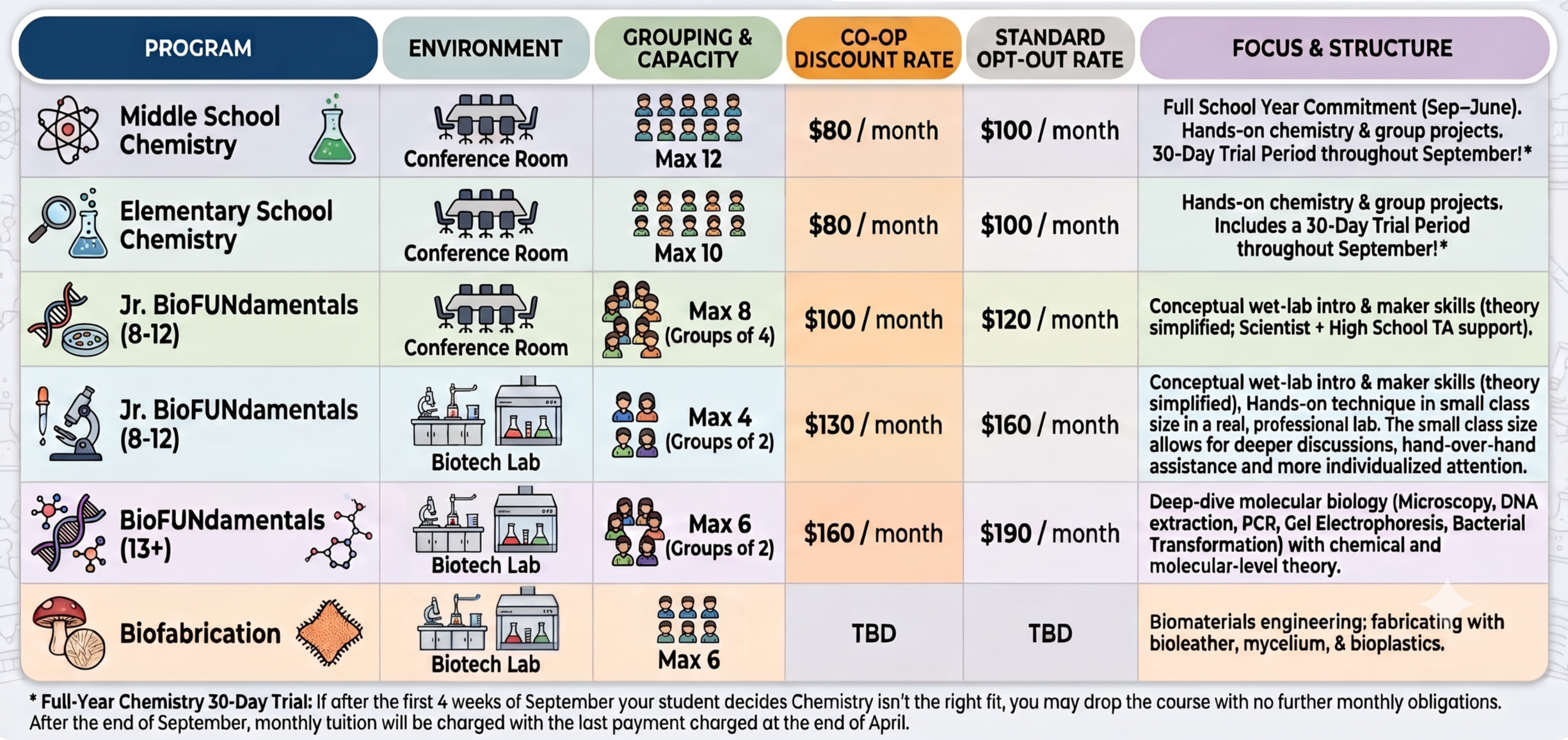
Middle School Chemistry (Grades 5–8): Full school year commitment; 36 classes total (billed in 9 monthly tuition installments).
Co-Op Rate: $80/mo (~$20.00 / class)
Regular Rate: $100/mo (~$25.00 / class)
Elementary School Chemistry (Grades 2–4): 12-week course; 12 classes total (billed in 3 monthly tuition installments).
Co-Op Rate: $80/mo (~$20.00 / class)
Regular Rate: $100/mo (~$25.00 / class)
Jr. BioFUNdamentals (Ages 8–12, Conference Room): 18 classes total (billed in 4 monthly tuition installments).
Co-Op Rate: $100/mo (~$22.00 / class)
Regular Rate: $120/mo (~$27.00 / class)
Jr. BioFUNdamentals (Ages 8–12, Biotech Lab): Small group setting; 18 classes total (billed in 4 monthly tuition installments).
Co-Op Rate: $130/mo (~$29.00 / class)
Regular Rate: $160/mo (~$35.00 / class)
BioFUNdamentals (Ages 13+, Biotech Lab): Advanced lab track; 18 classes total (billed in 4 monthly tuition installments).
Co-Op Rate: $160/mo (~$35.00 / class)
Regualr Rate: $190/mo (~$42.00 / class)
Why Do BioFUNdamentals Rates Differ?
BioFUNdamentals courses utilize specialized molecular reagents, professional lab equipment, regulated biological and chemical waste disposal services, and require extensive instructor prep time (preparing agar petri dishes, liquid growth media, agarose gels, buffers, and maintaining cell cultures).
Conference Room Track ($100–$120/mo): Available for Jr. BioFUNdamentals (8–12). Uses specialized reagents and equipment at a lower rate because facility room fees are lower and materials are shared in larger student groups (groups of 4, max 8 students per class).
Lab Track ($130–$190/mo): Billed at a higher rate due to professional laboratory facility costs and small group sizing (groups of 2, max 4 students per class) for individualized, hand-over-hand instruction.
Note on 13+ BioFUNdamentals: We do not offer a conference room option for the 13+ age group. Students in this age range benefit most from an authentic, immersive laboratory environment that mirrors what working in a real STEM career actually feels like. This course satisfies high school science lab requirements. It provides applied, hands-on labs across seven AP Biology study units. While it covers advanced lab techniques, it does not follow all FCPS High School Biology course standards, nor is it a comprehensive AP Biology test-prep course. The main purpose of this course is to prepare participants for independent research projects in the CELLS BioMakerSpace (science fairs, junior researcher publications) or external internship offerings and provides an overview of careers in biotechnology, a field experiencing high demand and designated as high priority for Maryland’s Frederick and Montgomery Counties.
Safety & Regulations
While no laboratory environment is risk-free, our curriculum providers and expert team thoroughly vet our unique BioFUNdamentals Program, our Chemistry Program, all materials, and lab spaces for safety. We actively mitigate risks through strict safety protocols, proper lab design, and active safety enforcement.
Our classes are safe when participants strictly follow lab safety rules. These rules are outlined in our Lab Safety Rules and Liability Waiver, which students and parents sign before classes begin. Instructors teach necessary safety protocols during classes and strictly enforce safety practices. If a student chooses not to follow these rules—including dress code requirements like wearing long pants, long sleeves, and closed-toe shoes (no short sleeves, shorts, or Crocs)—they cannot remain in the lab space.
All classes follow established regulations (such as hazardous waste disposal) and are directly supervised by trained instructors. Our main BioMakerSpace operates under Biosafety Level 1 (BSL-1) standards, the same standard used in high school and introductory college research labs, and works exclusively with non-pathogenic organisms and low-risk reagents. Personal protective equipment (PPE) is provided and sanitized after every use. Courses are led by our PhD-level Lead Instructor, who brings over 15 years of bioengineering industry experience to the lab.
Important Scheduling & Enrollment Notes
Weekly Schedule & Calendar: Programs meet once per week (approximately 4 sessions per month) until all scheduled course sessions are completed. Tuition is divided into a fixed number of equal monthly installments, regardless of how many class sessions fall within a particular month.
Flexible Cohort Options: Classes listed on multiple days or times are identical repeat sessions designed to accommodate multiple student cohorts. Simply choose the single weekly day and time slot that best fits your family’s schedule.
Fall & Spring Sequence: BioFUNdamentals is offered during the Fall term. CELLS Matter: BioFABrication runs in the Spring term within the exact same weekly time slots for seamless scheduling.
Check out our 2026-2027 info: PDF
Step-by-step registration instructions: PDF
How We Use Tuition Fees
Real Science. Real Laboratory Experiences. A Community Worth Building.
At CELLS, students use authentic laboratory equipment, practice scientific techniques, and learn through hands-on experimentation in small groups.
As a community-funded nonprofit, we rely on tuition, workshop fees, donations, grants, and volunteers to make these experiences possible.
Where Your Tuition Goes
Laboratory & Facilities: Safe, equipped learning spaces, insurance, utilities, and waste management.
Equipment & Materials: Scientific instruments, reagents, consumables, maintenance, and replacement.
Educators: Currently supported by volunteer professionals, with the goal of sustainably compensating qualified instructors and staff.
Operations: Registration, scheduling, communication, and administrative technology.
Why Does a Nonprofit Charge Tuition?
Nonprofit means our resources support our mission—not that education is free to provide.
Tuition helps sustain our programs and laboratory, and we reinvest the remaining revenue into CELLS. Grants, donations, and sponsorships also help us provide free community outreach and expand access to science education.
Every enrollment helps build a community where science is something you experience, not just read about.
Be Curious. Explore. Experiment. Create. Be You!